
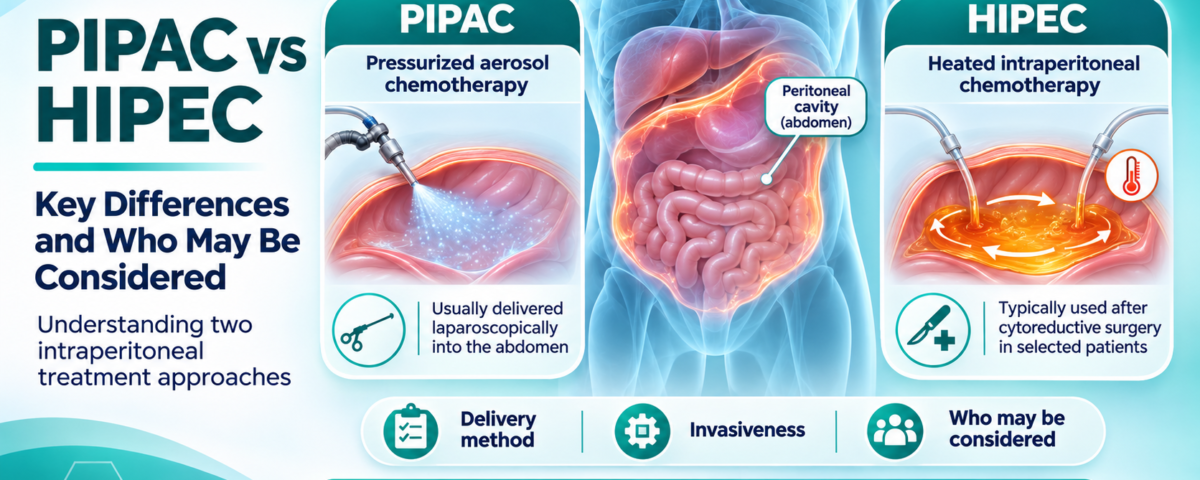
PIPAC vs HIPEC: Key Differences and Who May Be Considered
Both approaches deliver chemotherapy into the abdominal cavity, but they differ in how they are given, who may be evaluated, recovery expectations and strength of evidence. Understand these distinctions before discussing a plan with your oncology team.
CRS (cytoreductive surgery) removes visible tumor deposits; HIPEC circulates heated chemotherapy during surgery, often after CRS. PIPAC delivers pressurized chemotherapy as a mist through keyhole access without requiring tumor-removal surgery. Treatment goals and evidence vary by cancer type. See the evidence and limitations.
What are PIPAC and HIPEC used for?
PIPAC and HIPEC are forms of intraperitoneal chemotherapy: treatment delivered into the space around organs in the abdomen. They are sometimes discussed when cancer affects the peritoneum—the thin lining of the abdominal cavity and organs.
This spread is called peritoneal metastasis or peritoneal surface disease. It may arise from cancers of the appendix, bowel, stomach, ovaries or other sites. Some cancers begin in the peritoneum itself. The appropriate treatment depends heavily on the specific cancer, how extensively the peritoneum is involved, whether disease is present elsewhere and the patient’s health.
Surgery to remove visible deposits where safe and feasible.
Heated liquid chemotherapy circulated inside the abdomen, usually following CRS.
Pressurized chemotherapy aerosol administered through minimally invasive abdominal access.
Both techniques focus on local delivery, but neither replaces the need to discuss systemic treatments—such as intravenous chemotherapy or other cancer-specific medicines—when indicated. A patient’s treatment may involve several approaches, or neither.
PIPAC vs HIPEC: key differences at a glance
For people searching “PIPAC vs HIPEC Nagpur,” the main question is not which technique is newer. It is whether either offers a reasonable benefit for that person’s diagnosis and treatment goal.
| Feature | HIPEC (often with CRS) | PIPAC |
|---|---|---|
| Full form | Hyperthermic intraperitoneal chemotherapy. | Pressurized intraperitoneal aerosol chemotherapy. |
| How chemotherapy is delivered | Warmed liquid medicine is circulated through the abdominal cavity. | Medicine is dispersed as a fine mist under pressure. |
| Surgery involved | Usually given during a major operation following cytoreductive surgery (CRS). | Given during a laparoscopic procedure; removal of all visible tumors is not required. |
| Common treatment goal | Part of a potentially long-term disease-control strategy in selected, surgically treatable cancers; benefit of adding HIPEC varies by diagnosis. | Usually explored for disease control or symptom management in unresectable or recurrent peritoneal disease; investigational. |
| Can it be repeated? | Often a one-time chemotherapy phase in a major operation, though future procedures depend on the case. | May be performed in multiple sessions according to a specialist protocol. |
| Typical recovery burden | Generally greater because of the extent of accompanying surgery. | Usually shorter than recovery from CRS–HIPEC, but anesthesia and procedural risks remain. |
| Patient selection | Depends strongly on cancer type, peritoneal disease extent, surgical resectability and fitness. | Depends on tumor type, prior treatment, symptoms, fitness, procedural access and a specialist protocol or trial. |
| Evidence status | Established in some carefully selected settings; debated or limited in others, especially as an addition to CRS. | Emerging/investigational with ongoing clinical trials; not a proven substitute for CRS–HIPEC. |
Comparison is educational. Technical protocols, medicines, timing and indications differ between centers and cancer types. See Mayo Clinic’s explanation and the sources at the end of this article.
What happens during HIPEC and PIPAC?
HIPEC: usually after tumor-removal surgery
- The surgical team explores the abdomen and assesses the disease.
- When appropriate, CRS removes visible cancer deposits as completely as safely possible.
- Heated chemotherapy solution circulates in the abdominal cavity for a protocol-specific period.
- The team removes the solution and completes the operation; postoperative monitoring and recovery follow.
Key point: The operation, not just the heated chemotherapy phase, contributes substantially to treatment burden and recovery.
PIPAC: keyhole aerosol delivery
- Under anesthesia, the specialist accesses the abdominal cavity through laparoscopic ports where feasible.
- After assessment, chemotherapy is delivered as an aerosol using a controlled device.
- The medicine remains in the abdomen for a set time and is then safely evacuated via a closed system.
- Recovery is monitored; the team may consider additional cycles based on response and tolerability.
Key point: PIPAC is a drug-delivery approach, not a guarantee that cancer can be surgically removed later.
Both require trained teams, appropriate facilities, careful handling of chemotherapy, informed consent and postoperative follow-up. Exact steps can differ. Explore Dr. Krunal’s detailed CRS + HIPEC patient guide.
Who may be considered for PIPAC or HIPEC?
No scan finding or online checklist can establish eligibility. Multidisciplinary review is important because different tumors behave differently and not every patient with peritoneal spread benefits from abdominal surgery or intraperitoneal treatment.
When a CRS–HIPEC assessment may be discussed
- A cancer type for which specialized peritoneal treatment may have a meaningful role.
- Disease extent and distribution that might permit safe, sufficiently complete cytoreductive surgery.
- Acceptable overall fitness, organ function, nutrition and operative risk.
- A multidisciplinary plan that considers systemic treatment and expected quality of life.
Not everyone with limited disease needs HIPEC; the benefit of adding it to CRS is diagnosis- and protocol-dependent.
When a PIPAC assessment may be discussed
- Peritoneal disease that is unresectable, recurrent or otherwise not suitable for major cytoreductive surgery.
- A treatment objective centered on disease control and/or symptom relief.
- Acceptable anesthesia risk and safe laparoscopic access, assessed by the treating team.
- Access to an experienced center with an appropriate protocol, ideally within a clinical trial or prospective evaluation.
PIPAC remains investigational; availability and suitability should be confirmed directly.
Six details the team usually reviews
Biopsy/histopathology, primary tumor origin and relevant molecular findings when appropriate.
CT or other imaging, possible diagnostic laparoscopy and assessment of the Peritoneal Cancer Index (PCI) where relevant.
Location of implants, small-bowel involvement, other organ involvement and likelihood of safe cytoreduction.
Functional status, other medical conditions, blood counts, kidney/liver function and nutritional status.
Systemic chemotherapy response, prior operations, complications and potential treatment alternatives.
Whether the priority is durable disease control, symptom management or quality of life—and how much uncertainty is acceptable.
Extensive or rapidly progressing disease, unsafe abdominal access, significant organ dysfunction or poor fitness can make a planned procedure unsuitable. The most appropriate alternative may be systemic treatment, symptom-directed care, supportive care or a clinical trial. These are individualized decisions, not automatic exclusions for every patient.
Does HIPEC work better than PIPAC?
There is no reliable, universal “winner.” Comparing the two directly can be misleading because patients receiving them often have different disease burdens and treatment goals. Evidence also varies considerably by primary cancer type.
For colorectal cancer with peritoneal metastases
In carefully selected people, complete cytoreductive surgery (CRS) may be an important component of care. Whether adding HIPEC improves outcomes is more controversial and depends on the protocol and selection criteria. The Indian INDEPSO–ISPSM consensus recommends a selective approach and limits several forms of intraperitoneal chemotherapy outside clinical trials. Read the Indian expert consensus.
For appendix-related conditions and pseudomyxoma peritonei
CRS with HIPEC is a recognized approach in selected specialist-center cases, although disease grade, extent and completeness of resection strongly influence outcomes. PIPAC is being researched but should not be treated as an established equivalent. See a scientific overview.
For stomach and ovarian cancers
Intraperitoneal treatment decisions are highly context-specific. In gastric cancer with peritoneal spread, recent international consensus statements emphasize that both HIPEC and PIPAC have limited or investigational evidence in many settings. In ovarian cancer, an oncology team may discuss HIPEC in selected clinical scenarios, but it is not appropriate to generalize across all stages or treatment histories.
What about PIPAC research?
PIPAC is promising as a method to deliver local therapy and is studied for selected patients with peritoneal disease. However, demonstrating technical feasibility or temporary disease response is not the same as proving longer survival or a cure. Expert selection criteria exist, but longer-term clinical trial results are still needed. See the 2024 international PIPAC eligibility consensus.
Risks, recovery and quality of life
Recovery is affected by the cancer, previous treatment, anesthesia, underlying medical conditions and what was done during the procedure. Avoid comparing recovery based on the chemotherapy-delivery method alone.
CRS + HIPEC: major-operation considerations
- Longer hospital recovery and possible need for close postoperative monitoring.
- Bleeding, infection, blood clots or anesthesia-related complications.
- Risks related to bowel or other organ procedures, including leakage or altered bowel function.
- Potential kidney, blood-count or other chemotherapy-related effects depending on the drugs used.
PIPAC: less invasive does not mean risk-free
- Anesthesia, port-site or procedure-related complications.
- Pain, nausea, fatigue or transient changes in blood tests.
- Possible infection, bowel injury, adhesions or difficulty safely entering the abdomen.
- Chemotherapy-related side effects and uncertainty about long-term benefit.
Ask your care team how treatment may affect appetite, weight, mobility, daily activities, bowel function and the need for follow-up or systemic cancer therapy. Individual recovery estimates are more useful than fixed timelines.
Examples include high fever, severe or worsening abdominal pain, persistent vomiting, unusual bleeding, difficulty breathing or marked weakness. Emergency symptoms require urgent medical care rather than waiting for a routine clinic appointment.
How is a treatment decision made?
Understand the original cancer, previous treatment, and whether peritoneal involvement is suspected or confirmed.
Review imaging, distribution of disease, organ function and overall health; further tests may be recommended.
Consider CRS alone, CRS with HIPEC in selected situations, investigational PIPAC where appropriate, systemic therapies and symptom-directed care.
Discuss realistic expectations, alternatives, cost and availability, clinical trials, and the patient’s preferences.
Bring these records to your consultation
Questions worth asking the specialist
- Is the peritoneum the only site of spread, or are other organs involved?
- Would removing visible tumor deposits be feasible and worthwhile in my case?
- Would HIPEC add a meaningful benefit to CRS for my cancer type?
- If PIPAC is proposed, is it offered under a clinical trial or a structured protocol?
- What outcomes can realistically be expected, and what is still uncertain?
- What are the alternatives, side effects, recovery needs and total treatment costs?
Frequently asked questions about PIPAC vs HIPEC
Is PIPAC the same as HIPEC?
No. HIPEC uses heated liquid chemotherapy, most often during an operation after cytoreductive surgery. PIPAC delivers chemotherapy as a pressurized mist through laparoscopic access. Their goals, eligibility and evidence are different.
Is PIPAC better because it is less invasive?
Not necessarily. Recovery is usually less demanding than recovery after major CRS–HIPEC surgery, but a shorter procedure does not prove superior cancer control or survival. The right comparison depends on the patient’s disease and treatment goal.
Can HIPEC cure cancer that has spread to the peritoneum?
Some carefully selected patients with certain peritoneal cancers may undergo a potentially curative-intent approach involving complete cytoreductive surgery, sometimes with HIPEC. No cure can be promised, and adding HIPEC is not beneficial or indicated in every cancer type.
Is PIPAC a proven cure for peritoneal metastasis?
No. PIPAC is currently considered an investigational treatment. It is primarily studied for controlling disease and symptoms in selected settings, rather than as an established curative treatment.
Which cancers might lead doctors to discuss these techniques?
Depending on circumstances, specialist teams may assess patients with peritoneal spread from appendix, colorectal, stomach or ovarian cancers, as well as certain primary peritoneal malignancies. Indications and evidence differ substantially for each diagnosis.
Can someone receive PIPAC and later undergo CRS or HIPEC?
In selected cases, treatment response may lead teams to reassess whether surgery is possible. This is not a routine or predictable pathway, and there is no guarantee that PIPAC will make an initially unresectable cancer operable.
How many PIPAC sessions are needed?
There is no universally appropriate number. Some protocols involve repeated sessions, with the schedule guided by the diagnosis, response, tolerability, available evidence and treating center’s protocol.
What if I am not eligible for either procedure?
There may still be important treatment options, including systemic medicines, symptom management, nutrition and supportive care, or participation in a suitable clinical trial. Your oncology team should explain options aligned with your goals.
Where can I discuss PIPAC vs HIPEC in Nagpur?
Dr. Krunal Khobragade provides surgical-oncology consultations in Nagpur and lists experience with peritoneal cancer procedures on his official website. Contact the clinic for case assessment and to confirm the current availability, venue and suitability of any particular procedure.
What information should I send before an opinion?
Ask the clinic how to share pathology results, scan reports or image files, prior discharge papers, treatment summaries, blood tests and the patient’s current medicines. Do not send sensitive medical records to an unverified contact.
Discuss your peritoneal cancer treatment options with Dr. Krunal Khobragade
Dr. Krunal Khobragade is a Senior Consultant Surgical Oncologist in Nagpur. His official website lists training in cytoreductive surgery, HIPEC and PIPAC, including international training relevant to peritoneal cancer management. A consultation can help establish whether surgery, a specialist intraperitoneal protocol, systemic treatment or another approach merits further evaluation.
Website-listed credentials include an MCh Surgical Oncology gold medal, an ESSO fellowship in cytoreductive surgery/HIPEC, and training in HIPEC and PIPAC at the National Cancer Centre Singapore. See the official doctor profile.
Cancer Care, Aditya Enclave, Central Bazar Road, opposite Somalwar High School, Ramdaspeth, Nagpur, Maharashtra 440010, India.
Call: +91 92720 48876 · Book / enquire online · Find directions
The doctor’s website also lists consultations at HCG Nagpur Cancer Hospital and KIMS-Kingsway Hospitals. Confirm current consultation timings, procedural availability, hospital venue, appointment slots and insurance arrangements with the clinic. PIPAC is investigational; this webpage does not imply it is appropriate or currently offered to every patient.
Have reports and need an individual treatment opinion?
A specialist can review the diagnosis, disease distribution, previous treatment, clinical priorities and available options before discussing whether CRS, HIPEC or investigational PIPAC is relevant.
Related reading on Dr. Krunal’s website
Medical sources and further reading
- Mayo Clinic. Pressurized Intraperitoneal Aerosol Chemotherapy (PIPAC). Reviewed 2025.
- Tozzi F, et al. Standardizing eligibility and patient selection for PIPAC. European Journal of Surgical Oncology, 2024.
- INDEPSO–ISPSM Indian consensus on colorectal peritoneal metastases. JCO Global Oncology, 2024.
- Review of appendiceal mucinous neoplasms, pseudomyxoma peritonei and intraperitoneal treatments. 2026.
- Indian expert consensus on gastric cancer peritoneal metastases. 2025.
Medical information disclaimer: This article is for general patient education, not diagnosis, individual medical advice or a recommendation for a particular operation. Evidence and indications evolve, and all clinical statements must be reviewed by the treating specialist before publication. A personalized plan requires pathology, staging, multidisciplinary assessment and discussion of alternatives. Updated as a draft in November 2026.