

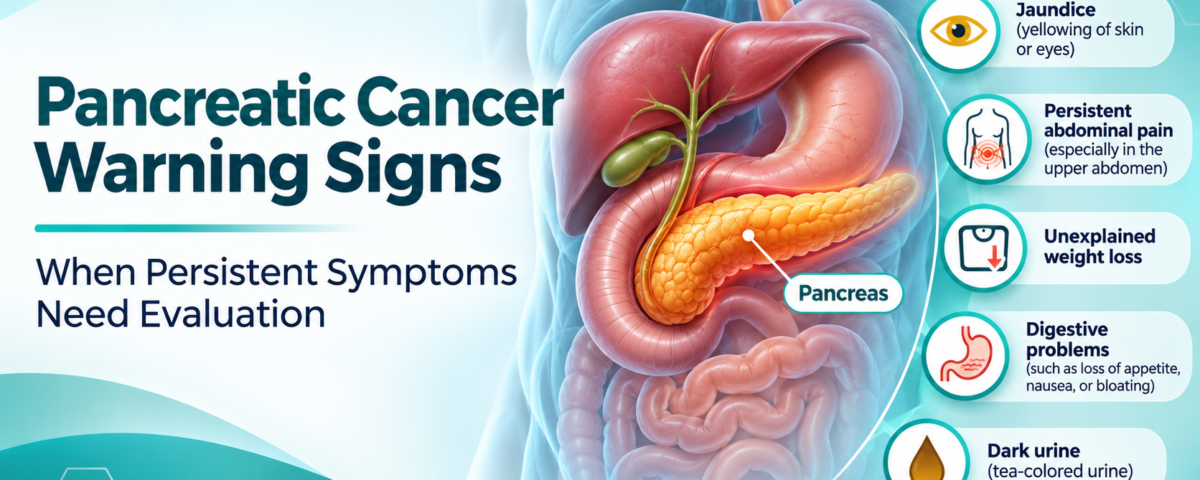
Pancreatic Cancer Warning Signs: When Persistent Symptoms Need Evaluation
Some pancreatic cancer symptoms resemble everyday digestive problems. Learn which changes deserve attention, when to seek medical help and what an evaluation may involve.
Patient education from Dr. Krunal Khobragade’s cancer-care website · Approximately 10–12-minute read
The pancreas, at a glance
A deep abdominal organ that supports digestion and blood-sugar regulation.
First, an important reassurance: Indigestion, back pain and weight changes are far more often caused by conditions other than pancreatic cancer. But new, unexplained or persistent symptoms—especially jaundice—should not be ignored. A medical assessment can help identify the cause.
What are the early warning signs of pancreatic cancer?
Pancreatic cancer can develop with few obvious symptoms at first. When symptoms occur, they may include yellowing of the eyes or skin, unexplained weight loss, persistent upper abdominal or back pain, poor appetite, changes in stools, and sometimes newly diagnosed diabetes. None of these symptoms alone confirms cancer.
The key question is not simply whether you have one symptom—it is whether a symptom is new for you, unexplained, getting worse, lasting despite usual care, or occurring with other warning signs. A clinician can consider your age, medical history, examination and the pattern of symptoms together.
Six symptom patterns that deserve attention
These are possible warning signs, not a checklist that diagnoses pancreatic cancer. The details and combinations matter.
1. Jaundice
Yellowing of the whites of the eyes or skin, sometimes with itching, dark urine and pale stools. It may happen if a blockage prevents bile from draining normally.
2. Upper abdominal or back pain
An ache or discomfort high in the abdomen that may extend to the back. Pain can have many explanations; a persistent or changing pattern warrants review.
3. Unexplained weight loss
Losing weight without dieting, particularly alongside reduced appetite, persistent digestive symptoms or fatigue, deserves attention.
4. Changes in digestion or stools
Pale or greasy stools, diarrhoea, nausea, bloating or indigestion that persists despite usual management can merit evaluation.
5. New or unexpectedly worsening diabetes
A new diabetes diagnosis later in life—especially alongside weight loss or other symptoms—can prompt a discussion about pancreatic health.
6. Ongoing fatigue or poor appetite
Persistent tiredness, reduced food intake, nausea or vomiting are nonspecific symptoms. A doctor can assess them, especially if several changes occur together.
This combination can indicate a bile-flow problem. Gallstones, liver conditions and other non-cancer causes are also possible.
When should you seek medical evaluation?
Do not use a fixed two-week waiting period if a symptom is severe or concerning. The following is general triage guidance; the right urgency depends on your situation.
Severe symptoms or signs of serious illness
Seek emergency care for severe or rapidly worsening abdominal pain, fainting, difficulty breathing, chest pain, or yellowing accompanied by fever/chills and significant illness. Persistent vomiting with dehydration also needs urgent care.
New jaundice, even if you feel relatively well
Yellow eyes or skin, particularly with dark urine or light stools, should be examined promptly. Contact a doctor or urgent medical facility on the same day; do not assume it is acidity.
Persistent or unexplained symptoms
Book medical review for noticeable unexplained weight loss, new or progressive upper abdominal/back symptoms, or digestive problems that do not improve—particularly beyond roughly two weeks of usual management. Seek review sooner if symptoms worsen or occur together.
If you cannot access a routine appointment and you are getting worse, use an urgent care service. An online article cannot assess your personal level of risk.
Why can pancreatic cancer feel like a digestive problem?
The pancreas sits deep in the upper abdomen, behind the stomach. It makes substances that help digest food and hormones, including insulin, that regulate blood sugar. Early changes in this organ may not produce obvious symptoms.
Symptoms can also differ according to where a problem is located. A growth near the head of the pancreas may press on a nearby bile duct and produce jaundice. Problems in the body or tail may not cause jaundice and can be noticed later through vague pain, appetite changes or weight loss.
Symptoms that can overlap
- Acidity or indigestion
- Gallstones or other bile-duct problems
- Peptic disorders or pancreatitis
- Musculoskeletal back pain
- Common blood-sugar conditions
What changes the picture?
- Symptoms are new or different for you
- They persist despite usual treatment
- They are progressive, not settling
- They occur with weight loss or jaundice
- There is important family history
Persistent symptoms do not mean cancer—but they do deserve a clear explanation, rather than repeated self-treatment without reassessment.
Patient education principle; not a diagnosis or prediction of risk.
How does a doctor investigate possible pancreatic symptoms?
Your first visit may be with a physician or gastroenterologist. Tests are selected from your history and examination; not everyone needs every test. If imaging raises concern for a pancreatic tumour, referral to a multidisciplinary cancer team may follow.
Clinical history and examination
Your doctor may ask when symptoms started, whether weight has changed, whether your eyes or skin have yellowed, your blood-sugar history, medicines, smoking history and any family history of pancreatic cancer.
Blood tests, when appropriate
Tests may include liver function and bilirubin levels, blood counts and glucose or HbA1c. These tests help investigate symptoms but cannot, on their own, confirm or exclude pancreatic cancer.
Abdominal imaging
Ultrasound may be a first test, especially for jaundice. A contrast-enhanced CT—sometimes with a pancreas-specific protocol—or MRI/MRCP may be needed depending on the findings. A normal initial test does not always end evaluation if symptoms remain concerning.
Specialist review and tissue sampling if indicated
Endoscopic ultrasound (EUS) with sampling, other procedures, or additional scans may be considered in selected patients. The treating team determines whether and when a biopsy is required.
Diagnosis, staging and treatment discussion
If cancer is confirmed, a team reviews the stage and treatment options. Surgical oncology is one part of this process; surgery is not suitable or necessary for every person.
What about the CA 19-9 blood test? CA 19-9 is sometimes used during cancer care, but it is not a reliable stand-alone screening or diagnostic test. Do not self-order it to rule pancreatic cancer in or out.
Who should be especially attentive to persistent symptoms?
Pancreatic cancer risk is affected by several factors, including increasing age, smoking, certain inherited genetic conditions or a strong family history, and chronic pancreatitis. New-onset diabetes in later adulthood may warrant particular attention when it appears with unexplained weight loss or other concerning changes.
Risk factors do not mean someone has cancer, and pancreatic cancer can occur without known risk factors. Routine screening is not recommended for the general population; some people with substantially elevated inherited or family risk may be offered specialised surveillance after assessment.
Getting appropriate pancreatic cancer evaluation in Nagpur
For people in Nagpur, the right starting point is a timely, in-person assessment—not assuming that symptoms require surgery. Depending on the findings, a physician or gastroenterologist may refer a patient for imaging, endoscopy or specialist surgical oncology review.
For suspected or diagnosed pancreatic cancer, Dr. Krunal Khobragade is a Nagpur-based surgical oncologist whose clinical interests include gastrointestinal and hepato-pancreato-biliary surgery. His existing pancreatic cancer surgery service page explains how specialists assess operability and treatment planning when a diagnosis has already been considered or established.
Dr. Krunal Khobragade
MCh Surgical Oncology (Gold Medal) · Senior Consultant Surgical Oncologist
Dr. Khobragade’s published profile lists MCh training at Tata Memorial Hospital and additional training in GI, HPB and robotic surgery. Appointments are offered at his Ramdaspeth clinic and his listed Nagpur hospital consultation locations. Confirm the appropriate location and current availability when booking.
Read the doctor’s verified profileHave persistent symptoms or a scan that needs review?
If you have concerning symptoms, start with timely medical evaluation. For a specialist opinion on suspicious imaging, confirmed pancreatic disease or surgical treatment planning, contact Dr. Krunal Khobragade’s team.
Aditya Enclave, Central Bazar Road, opposite Somalwar High School, Ramdaspeth, Nagpur, Maharashtra 440010, India.
Search clinic address on Google Maps ↗HCG Nagpur Cancer Hospital, Binaki, Nagpur; and KIMS-Kingsway Hospitals, Kingsway Road, Mohan Nagar, Nagpur. Confirm doctor availability and which location is suitable before visiting.
Confirm appointment details ↗Frequently asked questions about pancreatic cancer symptoms
These answers explain general warning signs and do not replace individual clinical advice.
What are the first signs of pancreatic cancer?
There may be no noticeable symptoms early on. Possible signs include unexplained weight loss, abdominal or back discomfort, jaundice, reduced appetite, altered stools and occasionally newly diagnosed diabetes. These symptoms have many other possible causes.
Can pancreatic cancer cause acidity or indigestion?
Pancreatic cancer can sometimes cause nonspecific indigestion-like discomfort, bloating or nausea. Most indigestion is not caused by pancreatic cancer. Symptoms that are new, worsening, persistent or associated with weight loss or jaundice should be assessed by a doctor.
Is back pain alone a sign of pancreatic cancer?
Back pain has many common non-cancer causes. Some pancreatic conditions can cause pain in the upper abdomen radiating to the back, but pain alone cannot establish a diagnosis. Seek review for unexplained, persistent or progressive pain, especially with other warning signs.
How urgent is yellowing of the eyes or skin?
New jaundice needs urgent, ideally same-day medical assessment, even if it is painless. Fever, chills, marked illness or severe abdominal pain with jaundice may indicate an emergency.
Does new-onset diabetes mean pancreatic cancer?
No. Diabetes is common and most people with diabetes do not have pancreatic cancer. New diabetes later in life, particularly with unexplained weight loss or other symptoms, is worth discussing with the treating clinician.
Which test confirms pancreatic cancer?
Diagnosis may involve specialist imaging such as a pancreas-protocol CT or MRI and, in many cases, a tissue sample obtained through a procedure such as endoscopic ultrasound. The exact pathway depends on scan findings and the clinical situation. No single routine blood test confirms pancreatic cancer.
Can a CA 19-9 test rule out pancreatic cancer?
No. CA 19-9 is not accurate enough to diagnose or exclude pancreatic cancer by itself and is not a general-population screening test. A clinician interprets it, if ordered, alongside symptoms, imaging and other results.
Where can I get a pancreatic cancer specialist opinion in Nagpur?
Start with a physician or gastroenterologist for unexplained symptoms. If scans are suspicious, pancreatic disease has been diagnosed, or surgery is being considered, you can contact Dr. Krunal Khobragade through his Nagpur appointment page or call +91 92720 48876. New jaundice or severe symptoms require prompt care rather than waiting for an elective oncology appointment.
Related reading and credible medical sources
After understanding symptoms, the next step depends on what your medical assessment shows. These pages explain relevant specialist services and treatment decisions—not substitutes for evaluation.
Medical references used for this article
Medical disclaimer: This content is general patient education and is not a diagnosis or treatment recommendation. It is based on publicly available clinical education resources. Clinical review by the treating specialist should be completed before publication. For severe symptoms, seek urgent medical care. Appointment locations, hours and service availability should be confirmed with the clinic.