

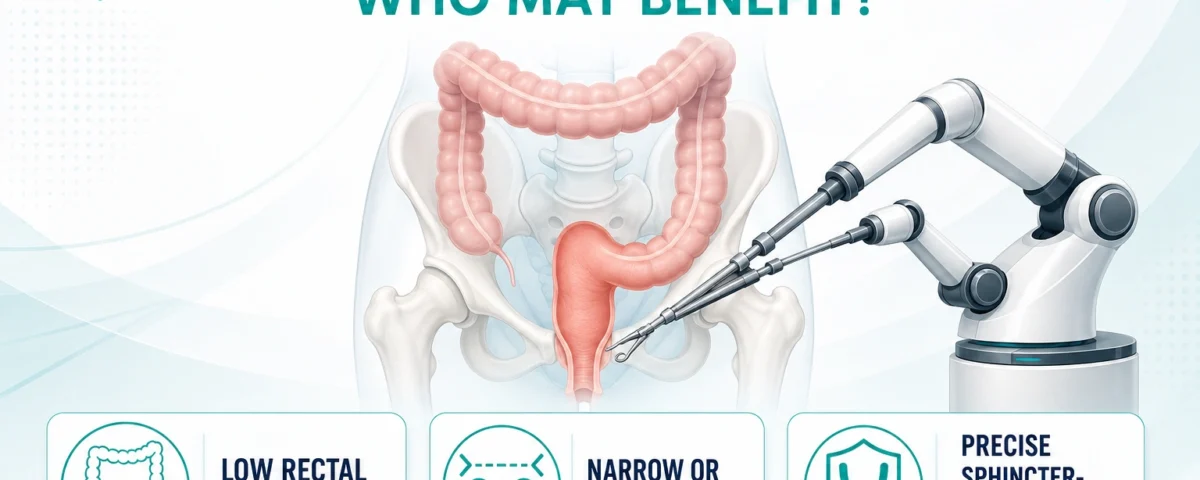
Robotic Surgery for Rectal Cancer: Who May Benefit?
Robotic surgery can be a useful minimally invasive option for selected rectal cancer patients—but it is not automatically the best approach for everyone. Here is how surgeons decide when it may be appropriate.
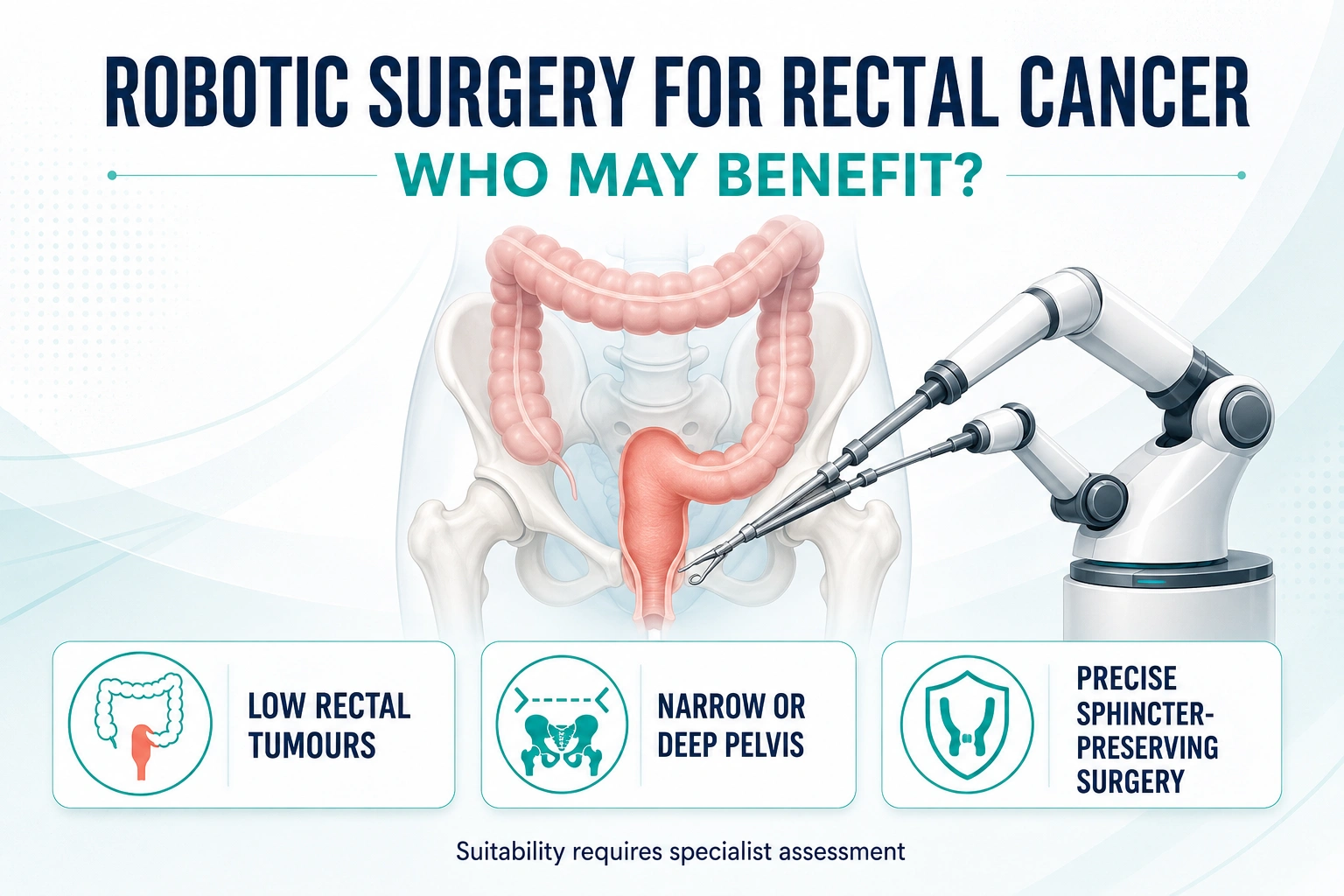
Why rectal cancer surgery is different
Rectal cancer develops in the final part of the large intestine, deep within the pelvis. This location can make surgery technically demanding because the rectum lies close to the anal sphincter, bladder, reproductive organs, nerves and major pelvic structures.
Treatment planning is also different from many colon cancers. Depending on the stage and tumour location, patients may need chemotherapy, radiation therapy or a combination of treatments before surgery.
What does “robotic rectal cancer surgery” actually mean?
In robotic surgery, the surgeon operates through several small incisions while controlling specialised instruments from a surgical console. The robotic system provides magnified three-dimensional visualisation and instruments with a wide range of movement.
The robot does not perform surgery automatically. Every movement is controlled by the surgeon.
Enhanced visualisation
Magnified 3D vision can help the surgeon see structures within the narrow pelvis.
Wristed instruments
Articulating instruments may make precise dissection easier in confined anatomical spaces.
Small incisions
Robotic surgery is a minimally invasive approach, generally performed through several small abdominal incisions.
Surgeon controlled
The surgeon remains responsible for every part of the procedure and controls the robotic system throughout.
Who may benefit from robotic rectal cancer surgery?
There is no single checklist that makes every patient suitable. The decision is made after reviewing the tumour, imaging, treatment already received and the patient’s overall fitness.
Robotic surgery may be considered when:
- The cancer can be removed safely using a minimally invasive approach.
- The tumour is located within the pelvis where precise dissection is required.
- The surgical plan involves low anterior resection or total mesorectal excision.
- Sphincter-preserving surgery appears oncologically feasible.
- Preoperative treatment has been completed and surgery remains appropriate.
- The patient is medically fit for the planned operation.
- There is no disease or anatomical factor that makes an open operation safer.
When may robotic surgery not be the right choice?
Using newer technology should never take priority over safe cancer surgery. Open surgery may be preferred when the surgeon expects that a larger incision will provide better control or a safer cancer operation.
- Very large or locally advanced tumours involving nearby organs
- Need for complex multi-organ resection
- Major vascular involvement
- Severe adhesions from previous abdominal or pelvic surgery
- Situations where safe cancer margins cannot be achieved minimally invasively
- Patient factors that make a different surgical approach safer
Can robotic surgery help preserve the anal sphincter?
One of the most common concerns patients have is whether rectal cancer surgery will require a permanent colostomy.
Many rectal cancers can be treated with sphincter-preserving surgery, but whether this is possible depends primarily on the tumour’s distance from the anal sphincter, how deeply it involves nearby tissues, response to preoperative treatment and whether adequate cancer margins can be achieved.
The robotic platform may assist precise pelvic dissection in selected cases, but the technology itself cannot guarantee sphincter preservation.
Robotic vs laparoscopic vs open rectal cancer surgery
| Approach | Potential role | Important consideration |
|---|---|---|
| Robotic | Minimally invasive pelvic surgery using surgeon-controlled robotic instruments. | Can provide enhanced visualisation and instrument movement; patient selection remains essential. |
| Laparoscopic | Established minimally invasive approach using a camera and long instruments. | Effective for many suitable colorectal operations. |
| Open | Direct surgical access through a larger incision. | May be preferable for complex, advanced or multi-organ disease. |
No approach is universally superior for every rectal cancer patient. The surgeon must balance cancer clearance, technical feasibility, recovery and patient safety.
How is the treatment plan decided?
Rectal cancer management is often multidisciplinary. Depending on the stage, treatment may include chemotherapy and/or radiation before surgery. Surgery is then planned after reassessing the tumour and the patient’s overall condition.
Questions to ask before deciding on robotic rectal surgery
- What stage is my rectal cancer?
- How close is the tumour to the anal sphincter?
- Do I need chemotherapy or radiation before surgery?
- Is sphincter-preserving surgery possible in my case?
- Would robotic, laparoscopic or open surgery be safest?
- Could I need a temporary or permanent stoma?
- What happens if minimally invasive surgery needs conversion to open surgery?
- What should I expect during recovery?
Robotic & colorectal cancer consultation in Nagpur
Dr. Krunal Khobragade is a Surgical Oncologist with international training in colorectal and robotic cancer surgery. Patients can consult for a new rectal cancer diagnosis, surgical planning, sphincter-preservation assessment or a second opinion on the recommended treatment sequence.
Ramdaspeth OPD: Cancer Care, Aditya Enclave, Central Bazar Road, opposite Somalwar High School, Nagpur.
Related information
Frequently asked questions
Is robotic surgery safe for rectal cancer?
Does robotic surgery mean the robot performs the operation?
Is robotic surgery always better than laparoscopic surgery?
Can robotic surgery prevent a permanent colostomy?
Do all rectal cancer patients need surgery?
Can surgery start robotically and become open surgery?
Medical references
- National Cancer Institute (NCI). Rectal Cancer Treatment (PDQ®).
- American Cancer Society. Surgery for Rectal Cancer.
- American Cancer Society. Cancer Surgery and Minimally Invasive Surgery.
Medical information is provided for education only and is not a substitute for individual diagnosis or treatment advice.