

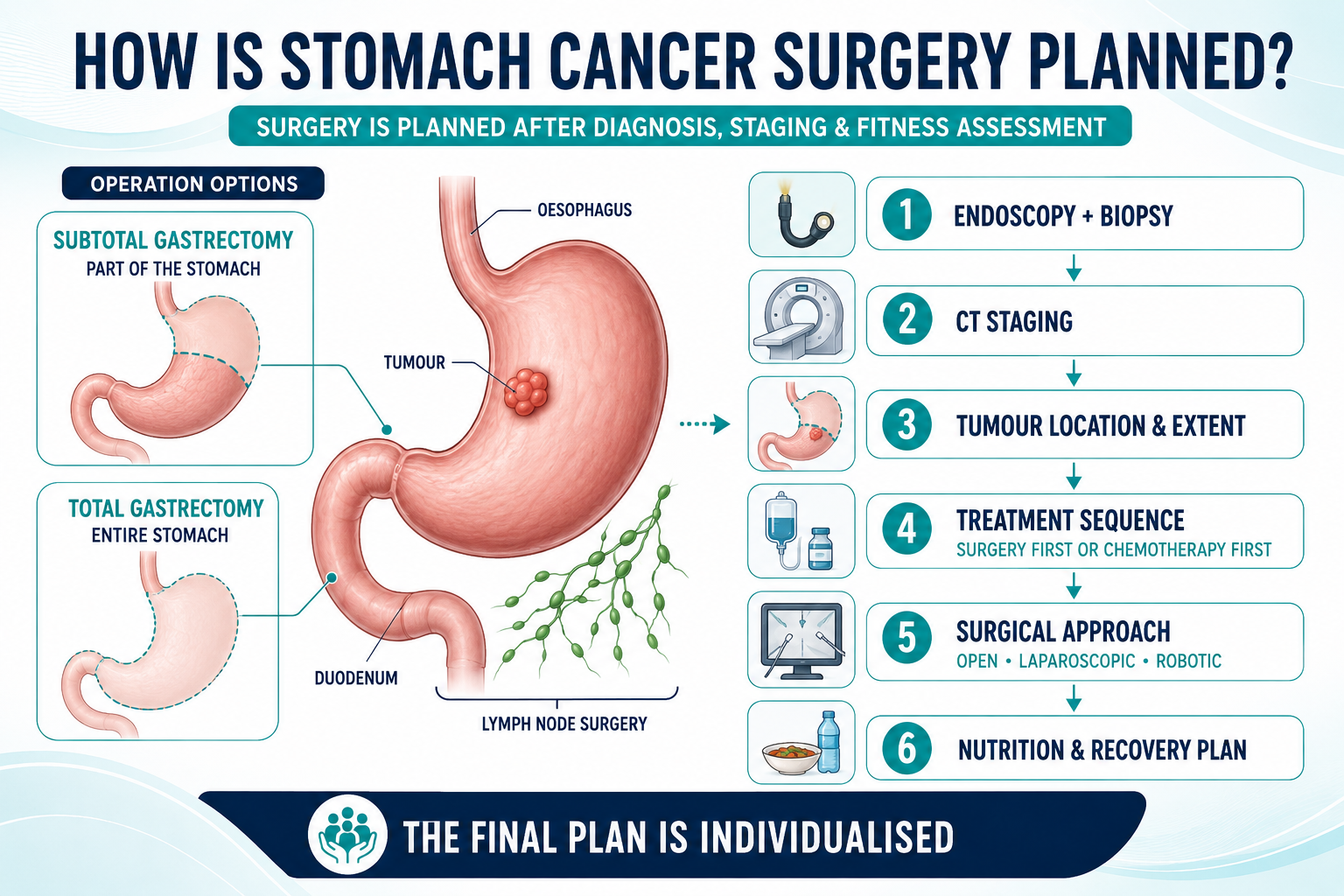
How Is Stomach Cancer Surgery Planned?
Stomach cancer surgery is not planned from the biopsy report alone. The surgeon first needs to understand where the tumour is, how far it has spread, whether lymph nodes are involved, and whether treatment should begin before surgery.
Step 1: Confirm the diagnosis and tumour location
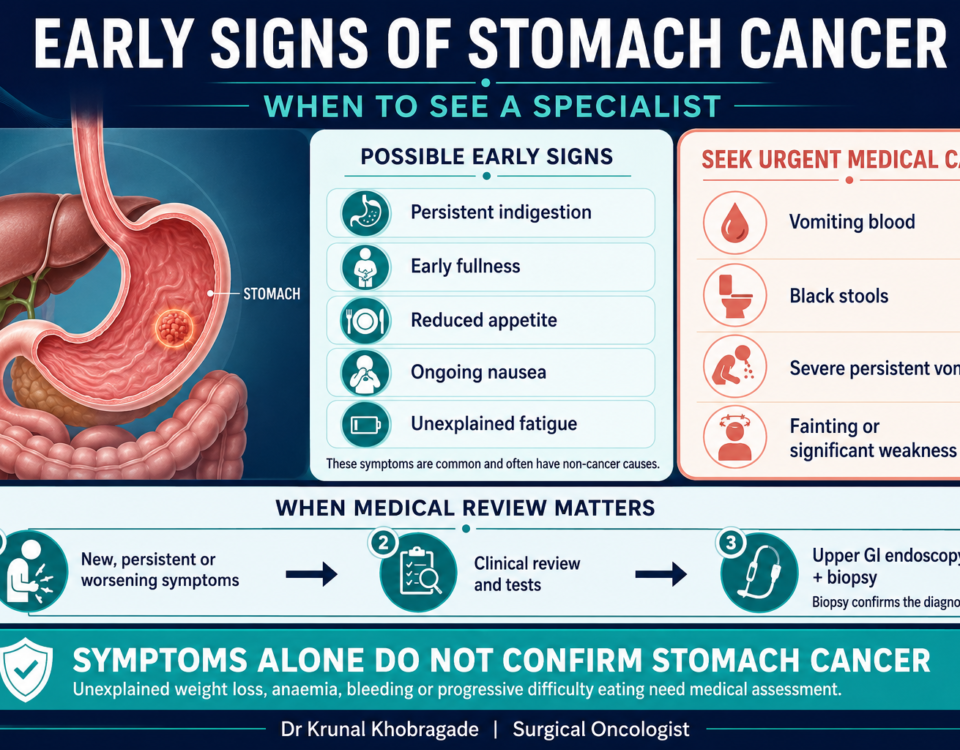
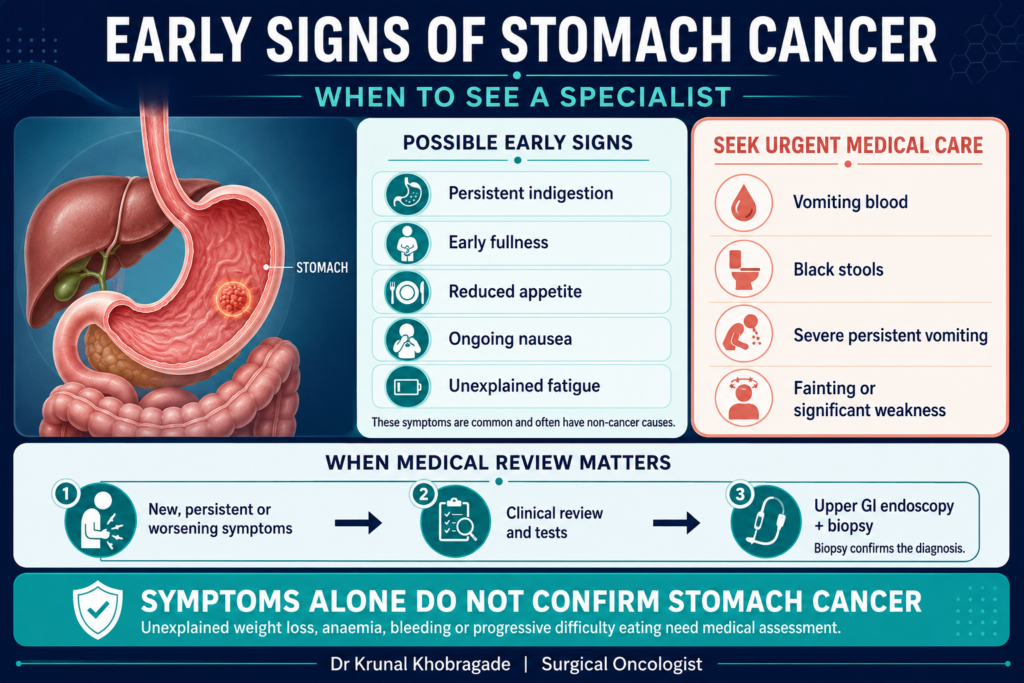
Most stomach cancers are diagnosed after upper GI endoscopy and biopsy. The pathology report confirms the type of cancer, while the endoscopy helps show where the tumour is located within the stomach.
Upper GI Endoscopy
Allows direct visualisation of the tumour and biopsy of suspicious tissue.
Biopsy
Confirms the cancer type and provides important pathological information.
Tumour Location
Helps determine whether part of the stomach or the entire stomach may need removal.
Step 2: Determine the stage before deciding on surgery
Staging is essential because surgery is most useful when the cancer can be removed completely and when there is no distant disease that would make another treatment strategy more appropriate.
- Contrast-enhanced CT scan of the chest and abdomen
- Additional imaging when clinically indicated
- Review of nearby lymph nodes and surrounding organs
- Assessment for spread to the liver, peritoneum or other distant sites
- Selected patients may need diagnostic laparoscopy before major surgery
Step 3: Decide whether surgery comes first
Some early stomach cancers may be treated with surgery first. Other patients may benefit from chemotherapy before surgery, followed by surgery and then additional treatment depending on the final pathology and overall treatment plan.
The exact sequence depends on tumour stage, location, pathology and the patient’s overall condition.
Step 4: Decide how much of the stomach needs to be removed
The aim is to remove the cancer with adequate margins while preserving as much healthy stomach as is safely possible.
| Operation | What it involves | When it may be considered |
|---|---|---|
| Subtotal / Distal Gastrectomy | Removal of part of the stomach, usually with nearby lymph nodes. | Selected tumours where adequate cancer margins can be achieved while preserving part of the stomach. |
| Total Gastrectomy | Removal of the entire stomach with reconstruction of the digestive tract. | Tumours whose location or extent makes partial removal inadequate. |
| Extended Surgery | Additional structures may occasionally need resection if directly involved. | Selected locally advanced cases where complete removal remains feasible. |
Why are lymph nodes removed during stomach cancer surgery?
Stomach cancer can spread through lymphatic channels to nearby lymph nodes. For this reason, a gastrectomy for cancer usually includes removal of regional lymph nodes as part of the operation.
The lymph-node findings also help determine the final pathological stage and may influence recommendations for additional treatment.
Can stomach cancer surgery be laparoscopic or robotic?
Selected patients may be candidates for minimally invasive gastrectomy using laparoscopic or robotic techniques. The suitability depends on tumour stage, location, anatomy, previous surgery and the complexity of the required operation.
| Approach | Potential role | Important limitation |
|---|---|---|
| Robotic | Surgeon-controlled instruments with magnified 3D visualisation. | Not appropriate for every stomach cancer or every required resection. |
| Laparoscopic | Established minimally invasive approach for suitable operations. | Technical suitability varies by case. |
| Open | Direct access through a larger incision. | May be preferable for complex, advanced or multi-organ operations. |
The priority is complete, safe cancer surgery—not choosing a particular technology.
What factors can change the surgical plan?
- Tumour location within the stomach
- Stage and involvement of nearby lymph nodes
- Spread to adjacent organs
- Presence or absence of distant disease
- Response to chemotherapy given before surgery
- Previous abdominal operations
- Patient age, nutrition and medical fitness
Nutrition is part of stomach cancer surgery planning
Stomach cancer can cause reduced appetite, early fullness, vomiting or weight loss. These issues may affect strength and recovery from major surgery.
The medical team may assess weight, nutritional intake and blood tests before surgery. Some patients may need nutrition optimisation before the operation.
What happens after the surgery?
The removed stomach specimen and lymph nodes are examined by the pathology team. The final report provides more accurate information about tumour depth, lymph-node involvement and surgical margins.
This final stage helps the oncology team decide whether additional chemotherapy or other treatment is recommended.
Questions to ask before stomach cancer surgery
- What stage is my stomach cancer?
- Do I need chemotherapy before surgery?
- Will I need a subtotal or total gastrectomy?
- How many lymph nodes are expected to be removed?
- Would robotic, laparoscopic or open surgery be most appropriate?
- Will any nearby organs need to be removed?
- How will eating change after surgery?
- What does recovery usually involve?
Stomach cancer surgery consultation in Nagpur
Dr. Krunal Khobragade is a Surgical Oncologist with a clinical focus on GI, colorectal and robotic cancer surgery. Patients can consult for a new stomach cancer diagnosis, gastrectomy planning, second opinion or assessment of minimally invasive surgical options.
Ramdaspeth OPD: Cancer Care, Aditya Enclave, Central Bazar Road, opposite Somalwar High School, Nagpur.
Related stomach and GI cancer information
Frequently asked questions
Does every stomach cancer patient need the whole stomach removed?
Can stomach cancer surgery be robotic?
Why are lymph nodes removed during gastrectomy?
Will I need chemotherapy before stomach cancer surgery?
Can stomach cancer surgery cure the disease?
How will eating change after gastrectomy?
Medical references
- National Cancer Institute. Gastric Cancer Treatment (PDQ®).
- American Cancer Society. Surgery for Stomach Cancer.
- National Comprehensive Cancer Network patient guidance for stomach cancer.
This article is for patient education and does not replace individual medical advice. Surgery planning requires review of pathology, imaging, stage and overall medical condition.