

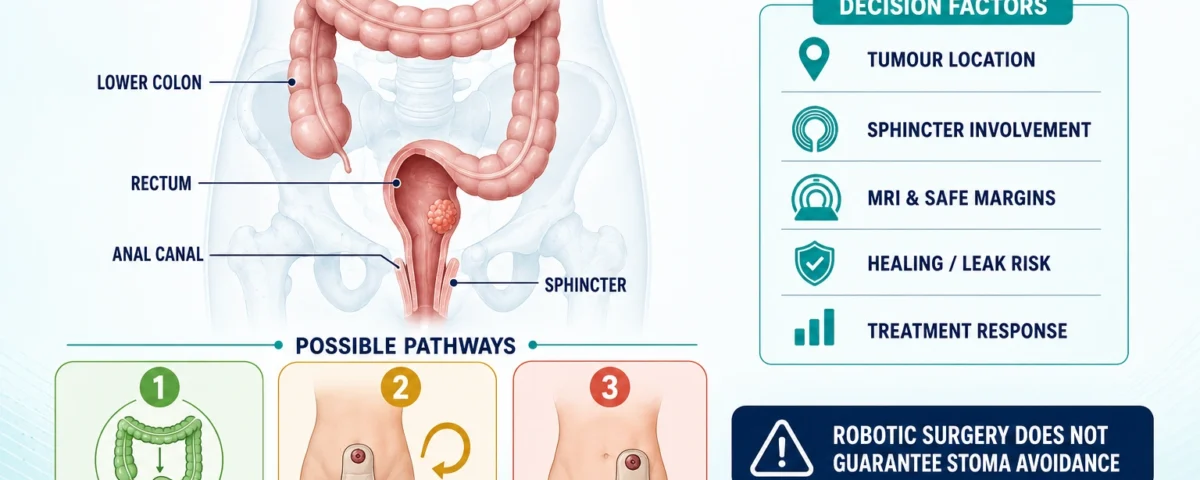
Do All Rectal Cancer Patients Need a Colostomy?
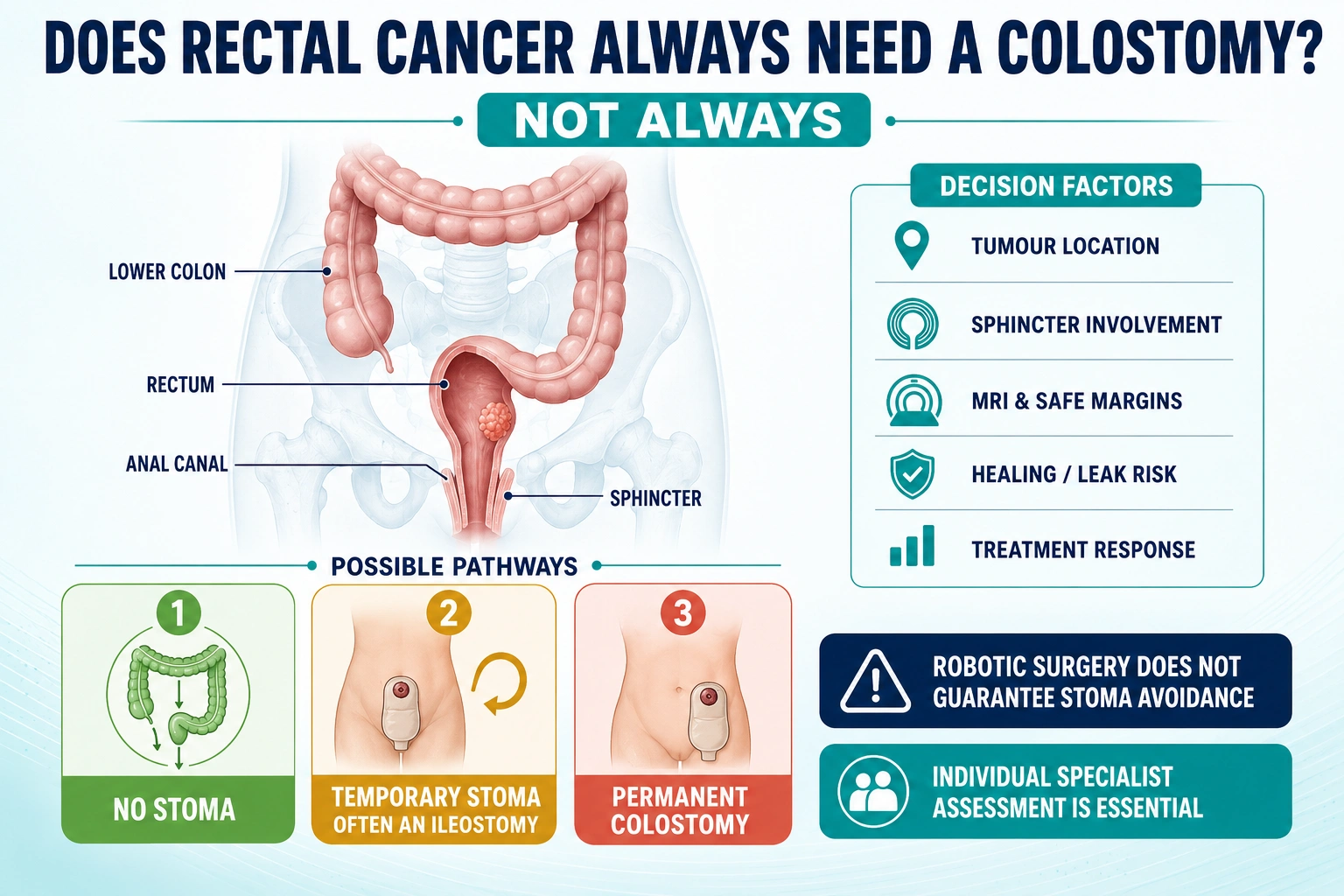
No. Many patients with rectal cancer do not need a permanent colostomy. Whether a stoma is needed—and whether it is temporary or permanent—depends on the tumour location, stage, surgical plan and ability to preserve a safe, functional connection to the bowel.
A permanent colostomy is required only in some rectal cancer operations. Other patients may need a temporary ileostomy or colostomy while a bowel connection heals, and many patients may ultimately pass stool through the natural route.
What is a stoma?
A stoma is a surgically created opening on the abdomen that allows stool to leave the intestine into a collection bag. Depending on which part of the intestine is brought to the skin, it may be called a colostomy or an ileostomy.
Colostomy
An opening created using the colon. It may be temporary or permanent depending on the operation.
Ileostomy
An opening created using the small intestine. In rectal cancer it is often used temporarily to protect a low bowel connection while it heals.
No stoma
Some patients can undergo bowel reconstruction without needing a stoma, depending on surgical and patient factors.
Temporary stoma vs permanent colostomy
| Temporary stoma | Permanent colostomy | |
|---|---|---|
| Purpose | Diverts stool away from a new bowel connection while it heals. | Provides a permanent route for stool when the anus and sphincter cannot safely be preserved. |
| Common type | Often a loop ileostomy in low rectal surgery. | Usually an end colostomy after removal of the anus and rectum. |
| Can it be reversed? | Often yes, after healing is confirmed and the patient is suitable. | No, when the anus has been removed as part of the cancer operation. |
| Needed for everyone? | No. | No. |
Why might a rectal cancer patient need a temporary stoma?
When the tumour is low in the rectum, the surgeon may need to remove the diseased segment and join the colon to the remaining rectum or anus. This connection is called an anastomosis.
If the connection is very low in the pelvis, the consequences of a leak can be serious. A temporary ileostomy may therefore be created to divert stool while the connection heals.
- Very low bowel connection after rectal resection
- Concern about healing of the new bowel connection
- Previous chemotherapy and radiation in some patients
- Patient health factors that may increase leak risk
- Complex pelvic surgery
When can sphincter-preserving surgery be possible?
Sphincter-preserving surgery means removing the rectal cancer while keeping the anal sphincter so that the patient may eventually pass stool through the natural route.
Procedures such as a low anterior resection, colo-anal anastomosis or selected intersphincteric resections may be considered when adequate cancer clearance can be achieved without removing the entire sphincter complex.
When may a permanent colostomy be required?
A permanent colostomy may be necessary when the tumour involves the anal sphincter or is positioned so low that the rectum and anus must be removed to achieve adequate cancer clearance.
One operation used in this situation is an abdominoperineal resection (APR). During APR, the rectum and anus are removed and a permanent colostomy is created.
Does chemotherapy or radiation affect whether a stoma is needed?
For many locally advanced rectal cancers, chemotherapy and/or radiation may be given before surgery. This can treat microscopic disease and may shrink the tumour.
Response to treatment can influence the surgical plan, but it does not guarantee that a stoma can be avoided. Tumour anatomy, sphincter involvement and safe surgical margins remain critical.
Can robotic surgery prevent a colostomy?
No surgical platform can guarantee that a patient will avoid a stoma.
Robotic surgery may help the surgeon perform precise dissection within the narrow pelvis in selected patients, but the decision about sphincter preservation depends on the cancer itself—not simply whether surgery is robotic, laparoscopic or open.
If I get a temporary ileostomy, when can it be reversed?
Reversal is considered only after the bowel connection has healed adequately and the treating team feels it is safe. The timing can vary depending on recovery, postoperative complications and whether additional cancer treatment is required.
Before reversal, the surgeon may perform tests to assess the bowel connection.
What happens after stoma surgery?
Patients are taught how to manage the stoma and appliance before discharge. A trained stoma or ostomy-care professional can help with pouch fitting, skin care, diet and practical daily concerns.
Many patients return to routine activities after recovery. If the stoma is expected to be temporary, the team will explain the conditions that need to be met before reversal.
Questions to ask your rectal cancer surgeon
- How close is my tumour to the anal sphincter?
- Does the MRI show sphincter involvement?
- Is sphincter-preserving surgery oncologically safe in my case?
- Would I need a temporary ileostomy?
- What factors would make the stoma permanent?
- If temporary, what needs to happen before reversal?
- Would chemotherapy or radiation be needed before surgery?
- Would robotic, laparoscopic or open surgery be most appropriate?
Rectal cancer surgery consultation in Nagpur
Dr. Krunal Khobragade is a Surgical Oncologist with training in colorectal and robotic cancer surgery. Patients with newly diagnosed rectal cancer can consult to understand staging, treatment sequence, sphincter-preserving options and whether a temporary or permanent stoma may be required.
Ramdaspeth OPD: Cancer Care, Aditya Enclave, Central Bazar Road, opposite Somalwar High School, Nagpur.
Related rectal cancer information
Frequently asked questions
Does every rectal cancer patient need a colostomy?
Can a temporary stoma become permanent?
What is the difference between an ileostomy and a colostomy?
Can a very low rectal cancer be treated without permanent colostomy?
Does robotic surgery guarantee sphincter preservation?
Is a permanent colostomy a treatment failure?
Medical references
- National Cancer Institute. Rectal Cancer Treatment (PDQ®).
- American Cancer Society. Surgery for Rectal Cancer.
- National Comprehensive Cancer Network patient guidance for rectal cancer.
This article is educational and does not replace individual medical advice. Treatment and stoma decisions require review of the patient’s pathology, imaging and clinical findings.